How I Fixed a Broken Accounts Payable Process for a $15M Nonprofit
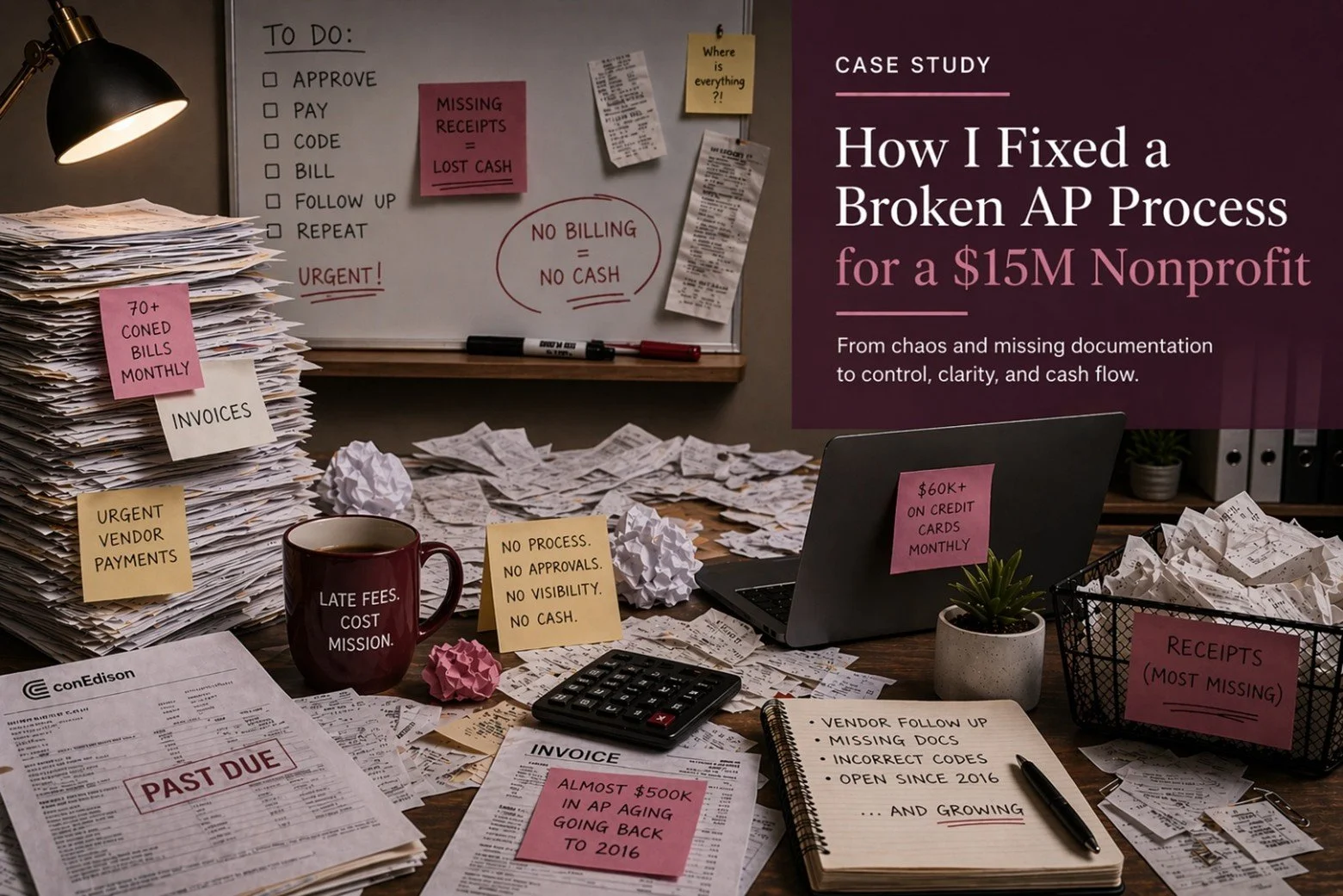
What a Truly Broken Accounts Payable (AP) Process Looks Like
I was engaged by a $15M nonprofit housing organization with a big mission, a talented Executive Director, and an AP process that was an absolute disaster.
When I say disaster, I don’t mean “a little disorganized.” I mean no process at all. Let me paint you a picture of what I walked into.
No approvals. No process. 100% paper.
Invoices sitting on desks, going missing, or forgotten all together.
Every single invoice had to be hand-typed into the system by the AP Clerk, one by one.
This may have worked for them when they were a small organization, but at this point, the volume had become brutal.
This is a housing organization, so they had around 70 ConEd bills alone coming in every single month. That’s before all their other bills.
The manual process couldn’t keep up, vendors weren’t getting paid, and it had gotten so bad that ConEd was asking for a significant deposit just to keep the lights on.
Credit card receipts were taped to paper, hand-delivered to AP at headquarters, and constantly lost. In fact, when I walked into the organization, there were a year’s worth of credit card transactions that had never been entered into the general ledger system.
On top of all that, their general ledger was a mess. Their AP Aging report showed around $500K with open invoices going back to 2016. The AP Clerk had been given zero training on their complicated coding structure, so bills were coded inconsistently or just plain wrong. The AP and accounts receivable sides of the house were, to put it charitably, a hot mess.
Missing Documentation Was Killing Their Cash Flow
Here’s why the missing documentation really mattered: they were running out of money and those invoices and receipts were the evidence this organization needed to bill against their grant contracts and receive cash.
No paperwork → no billing
No billing → no cash
They were leaving real money on the table because the documentation was a disaster.
But, the cash issue wasn’t just from missed billing. Multiple staff members were putting money on corporate credit cards with zero approvals. We’re talking $60K+ a month across the organization, and the org didn’t have the cash to cover it. The late fees were out of control.
A Back Office That Hadn’t Kept Up
To be clear, this wasn’t a case of bad leadership. The Executive Director had done remarkable things growing this organization and its reach. The back office just hadn’t kept up.
That’s where I came in.
Where We Started: AP and Expenses Were the Biggest Pain Point
The financials were an absolute disaster across the board when we walked in. Fixing them required a full overhaul of basically everything.
The right long-term fix was a new general ledger system, but that wasn’t in the cards budget-wise at that point in time.
AP and expenses were actively blocking the organization from functioning and from bringing in cash, so that’s where we focused first.
Rebuilding the Financial Reporting Structure
Before we could implement anything related to AP, we needed a foundation that made sense.
Part of the larger overhaul was rebuilding the financial reporting structure from scratch. Whatever logic the old structure was following was a mystery to everyone involved. We had to remap the chart of accounts to reflect how the organization actually operates, tracks dollars, and reports to funding sources.
This gave us the right foundation to start building the AP process.
Implementing the AP System
We selected the right AP platform for their needs after quite a few demos. But implementation isn’t just logging into a system and using it. You need to build out the process before automating it, which means digging into the process and making some critical decisions, like:
how you want the workflow to behave
how the data should be configured to feed into the next process
who uses what, who enters what, and who approves what
what happens when something gets kicked back
etc.
Not thinking about these things in the beginning is one of the ways in which implementations generally fail.
Luckily, we had been in the weeds at this company for several months already and knew some of these answers. But we didn’t know them all, so we started scheduling discussions and information gathering sessions to understand all the nuances we needed to get this implementation right.
Once we had the information we needed and had made as many of these decisions as possible, we moved forward with mapping out and configuring the system to work the way the organization does.
We made sure that the data was usable by the next process, that the approvals added real control without adding unnecessary bottlenecks, and that the right people had the right access.
Then we continued to make tweaks during the roll-out phase as we identified outliers that needed addressing. All a normal part of implementing a system, by the way.
Bridging the Gap to the General Ledger
One big wrinkle was the general ledger system.
It’s older, it lives on their servers (not the cloud), and it doesn’t connect to anything. No integration, no API, no automatic data transfer of any kind. Whatever goes into it has to be put there manually.
I needed to figure out how to get clean data from the AP system into the general ledger without adding cost, without adding complexity, and without anyone having to type everything in by hand again. It also needed to be simple enough that a non-tech-savvy team could run it without breaking a sweat.
The vendor offered Excel mapping templates, which were helpful. The problem was that their templates did not directly map to how this particular organization uses this particular general ledger system.
Being the Excel guru that I am, I revamped and massaged the templates according to this particular general ledger instance. I had to account for constraints like character limits and accepted formats or data types. This particular general ledger system is not known for its helpful error codes, so I had to interpret what a “MISSING FKsubID” meant.
After all of that was sorted out, we had reduced a process that used to take days down to a few minutes: download from the AP system, paste into the template, upload into the general ledger. Done.
Policies, Procedures, and Training
When the system was ready to go live, we shifted focus to policies, procedures, and training materials. After all, the greatest system in the world will never work if nobody knows how to use it.
I wrote everything myself, tailored specifically to this organization. Not generic templates, but materials that reflected their actual codes, their actual workflow, and the specific information their team needed to do the job right. They did not have any policies or procedures before I got there, so there was a lot to write. I even created a procedure document to describe how to fix issues like “MISSING FKsubID”.
The AP Clerk was a big part of this. She’d been thrown into a complicated job with no training and was understandably overwhelmed. I worked closely with her until she felt confident, and she told me I was the best teacher she’d ever had for this kind of work. That one meant a lot.
What It Actually Takes to Get This Right
A few things were non-negotiable:
Developing a deep understanding of the organization, the accounting, the technology, and how it all needs to work together.
Designing backwards from the reporting and billing outcomes we actually needed.
Building workflows that worked in real life, not just on paper.
Aligning everything to work within real constraints, including the budget and the staff’s capacity.
And iterating, because iteration is part of implementation, not a sign that something went wrong.
I also spent time setting expectations with leadership. When you’re automating something that was never automated before, you will make tweaks. That’s normal. Without having done this before, someone may not know, so I ensured that they understood that.
The Results: From Chaos to a Functioning Accounts Payable Process
The transformation was significant. Vendors were getting paid on time. The late fees stopped. Because the documentation was finally organized, the organization could bill against their grant contracts and cash started flowing. The AP Aging report, which had sat at $500K with invoices going back to 2016, was cleaned up. Leadership had visibility into what was being spent and by whom, for the first time ever. And the AP Clerk, who had been drowning, was confident and capable.
AP went from the thing that was actively breaking this organization to something that just… worked.
Is This Your Organization?
If you read this and recognized your own back office, you’re not alone. A lot of nonprofits are in exactly this situation: growing mission, talented leadership, and a financial infrastructure that hasn’t kept up.
That’s what I do. I come in, figure out what’s actually broken, build a structure that works, and make sure the people running it know what they’re doing.
No generic solutions, no unnecessary complexity, and no disappearing after go-live.
If you’re ready to stop leaving money on the table, let’s talk.